Alice Glasnerová
Alice Glasnerová: timeline
Erwin Kohn: timeline
Dora Kleinová: timeline
Helena Petranková: timeline
The Komenský Hospital in the Second World War
The Second World War
The Noel Field connections
The Slánský Trials
Prison regimes
Original documents
Publications
Bibliography
The Komensky Hospital in the Second World War:
In Alice’s footsteps (September 2019)
Much of this trip is also described in my blogs. (see Bienvenida Espana 9 Sept. 2019
-
We arrived in Spain by boat to Bilbao and drove first to Guadalajara. Having been
starved of investment during the Franco era as punishment for its loyalty to the
Republican cause, it is now a pleasant town destined to be a dormitory for commuters
to Madrid. The old town on the hill has been restored and the Palacio del Infantado
is now resplendent in honey-
We found the convent, but were only able to visit the church, the rest having been returned to the nuns. There is no mention of the period when the convent was used as a hospital. The only references to the Civil War are the memorials to the three nuns who were killed by Republicans when they first took over the town and forced the nuns to leave the convent.
The well-
From Guadalajara, we went on to Albacete, where we stayed in the Grand Hotel, not realising that it had been the headquarters of the international brigades. Some floors were also used for convalescents on their way home to recover. CEDOBI, which is a central archive about the international brigades, produced a booklet of the key sites to visit, so we walked around the town identifying buildings which had been used by the international brigades. We also saw the entrance to the bunker in the central square which had been used as a shelter from the Nationalist bombing.
On our second day we were able to visit the CEDOBI offices and a really helpful guide came and showed us more of the town, including the bullring where the recruits were enlisted and the fairground where they were billeted. Despite having been a centre for the international brigades, the town has no plaques or memorial commemorating its role in the war and our guide told us that people here do not want to remember.
Our next destination was Benicasim and there we had arranged to meet Guillen Casan, who has written extensively about the international brigade hospital and has been active in ensuring as many of the original villas as possible are preserved. We met at a cafe just above the site of the old railway station and walked along what had been the railway, but is now a cycle track. Once again, the little town is a holiday resort and the hotel has reverted to its original name of Hotel Voramar.
On the day we visited there were lots of stalls and people dressed in vintage costumes. We walked all along the front, where Guillen was able to point out the original villas and explain their use in the war. He became interested in this history because, as a small boy, his father had lived here and had visited the cultural centre often. He had borrowed books from their library and, as a result, had opened a bookshop in later life. Guillen also showed us the memorial he and others had erected, but unfortunately it is regularly defaced. We were able to see the villa where the Czech hospital was based and walk along the seafront as Alice and others had done, albeit in very different circumstances.
From Benicasim we moved on to Mataro where, again, we had a guide to show us round
the hospital premises. Our guide was Josep Xaubet and we met him outside the huge
building which had reverted to its pre-
The staircases and basement corridors were the same as they had been in Alice’s time
and some of the beautiful original tiles also remained. The refectory was still in
use for the same purpose by the school, but obviously all the rooms around the cloisters
and courtyards were now modern classrooms. Josep’s interest had been roused in this
aspect of his town’s history, by his grand-
He was a fierce supporter of Catalan independence, and when we visited, the Catalan
politicians were still in prison. Catalonia was the last bastion of the Republican
government and the hostility between Catalonia and Madrid is still rooted in that
conflict. Josep showed us a small memorial in the grass outside the school, but said
the school was resisting having a plaque on its wall explaining the history of the
building. Although some of the students do write about the Civil period, their sympathies,
as members of a Catholic convent tend to be anti-
After visiting the school, we went to the town cemetery, where there was a memorial to those members of the international brigades who had died in Mataro during the war. The area in which they were buried, however was left unmarked.
From Mataro we travelled to Vic, where again we had a most helpful guide, Manel Montero
Cueto. Manel was a police officer, who dealt mainly with traffic safety. Unlike Guillen
and Josep, his interest in the international brigades did not stem from family connections.
One All Souls day, he had met a young Australian woman in the cemetery in Vic. She
was looking for evidence of her uncle’s grave, as he had been a volunteer in the
Civil War and had died in Vic. Since then, Manel has helped the family trace their
relative and he has written a book describing their story and connection -
Manel took us to see the convent school in the city centre where the hospital had been based. As in Mataro, the buildings have reverted to their former use and it was the first week of term. We walked through the courtyards thronged with teenagers as Manel showed us the courtyards and classrooms which had housed the hospital. He related stories of Hemingway’s visit to a friend who was a patient there and said that the nurse in For Whom the Bell Tolls was based on a nurse he met here. He had also found death certificates from the period signed by Dora Klein.
From the hospital/school, we went to the cemetery, where he had first met the woman who set him on his journey of discovery into the history of his own town and community. It was a peaceful sunny day and rabbits nibbled at the short grass. Although there was a list of the men who had died there, there was no mention of their contribution to the international brigades. Manel explained how resistant the community was towards exploring this aspect of their history. Although he was welcomed regularly into schools to talk about road safety, none were prepared for him to give a talk on the Civil War or the international brigades.
Having written his book about Kevin, he was now exploring the history of those who had fled the Nationalist advance at the end of the war and ended up in camps in France. When the Germans invaded France, they asked Franco if he wanted the Spaniards repatriated, but he did not and so they were taken to Mathausen, where they were forced to build the camp. Many perished there. Manel would like to institute stumbling stones (like the German Stolpersteine), small brass plaques in the pavement, to record where the victims of the Holocaust had lived. So far, few are interested in the story.
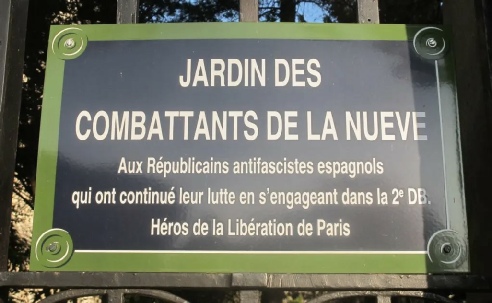
He also told us about the Spanish who did manage to remain at large in Europe and who joined the Allied Forces. When the Allies liberated Paris, the Spanish troops were among the first to enter and plastered on the
front of their armoured cars were the names of the battles of the Civil War: Brunete, Ebro, Guadalajara, Jarama, Teruel and so on…
Our last day in Spain took us to Figueres, which was near the border with France. There is a huge fort in Figueres, which was used at the beginning of the war as a reception centre for the international volunteers who crossed the border nearby and, at the end of the war, as the final bastion of the Republican government. According to my father’s statement to the United States Employers’ Loyalty Board, it was from here that Alice sent the telegram telling him she had gone to Spain.
We walked through the almost empty fort, through vast courtyards where military drills had taken place. Endless stables, with stalls for hundreds of horses, stretched away into the distance. During the Civil war, they had been used as temporary accommodation for the men, before they were moved on to Albacete to be deployed. There was little information about the international brigades, this could have been any abandoned fort and, unlike the crowded Dali Museum close by in the town, it was deserted.
Our final stop was not in Spain at all, but in Perpignan. We crossed the border via
the small road, which took us through Port Bou and Cerbere, the little border towns
where Alice and so many others had crossed first from France into Spain and then
back again. An exhibition of photographs was placed at the border, showing the thousands
of desperate refugees who had fled across in advance of the Nationalist victory.
At the time they were herded into camps, like St Cyprien, Argeles-
In Perpignan I wanted to try and find the prison where Alice had spent a month after her escape from Spain. We stayed in a hotel in what is now Avenue General De Gaulle, a straight road that leads directly from the station into the town centre. We soon realised that this must have been the road down which Alice was escorted to the prison and we found the statue of Jean Jaures that she mentions in her account of the arrest. As she had arrived in Perpignan before crossing into Spain, she must have seen and and read the inscription then, noticing it again as she was escorted past it on her return.
We found the prison down a small street and were surprised to see it look exactly like an archetypal prison. It had bossed stone walls and thick bars over the windows. We were able to go in and discovered that the men’s section was closed and would be refurbished to house an exhibition about the refugees from the Spanish Civil War. The women’s section had been refurbished and housed an exhibition about Algeria. We were therefore able to see both the communal room downstairs where Alice spent her days and the small cells upstairs where she had slept.